
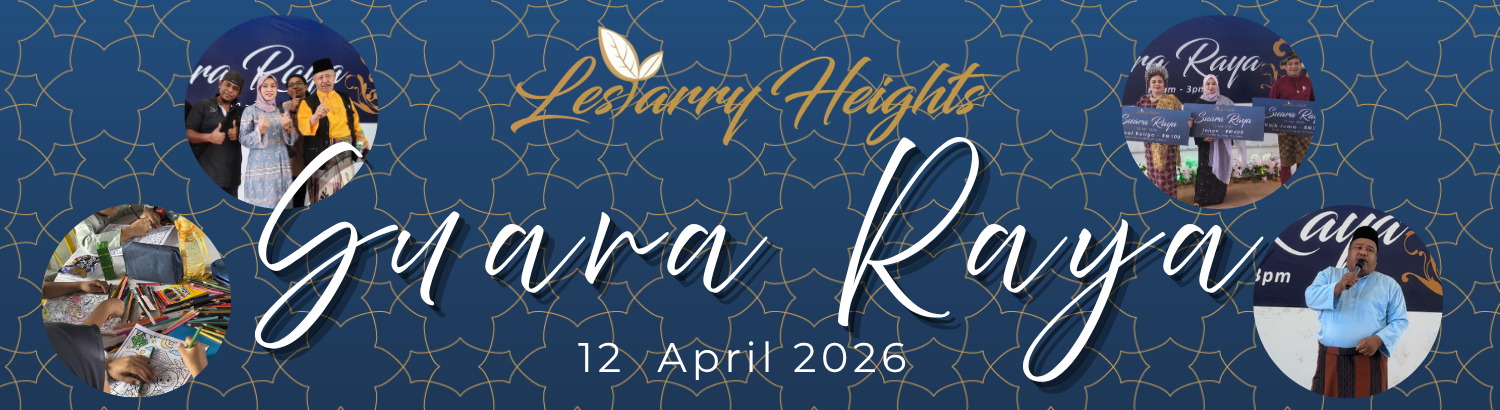
On a bright Sunday morning, 12 April 2026, the grounds of Lestarry Heights in Mentakab took on a familiar festive rhythm. Families arrived in soft hues of pastels and traditional wear, children in tow, as the scent of nasi briyani and ayam masak merah drifted through the air. By mid-morning, more than 200 people had gathered—some from as far as Johor and Kuala Lumpur—drawn by a simple promise: a relaxed Hari Raya get-together with a touch of friendly competition.
Organised by MZEC Development Sdn Bhd, the event reflects the developer’s ongoing commitment to fostering inclusive, people-centric communities. Beyond bricks and mortar, the company has consistently emphasised the importance of placemaking—curating shared experiences that encourage neighbourly interaction, strengthen social bonds, and cultivate a sense of belonging among residents and the wider community.
This was the second instalment of the community’s singing showcase, following its 2023 debut, and it returned this year under a new name—Suara Raya. Less a high-stakes contest and more a shared stage, the programme became the emotional centrepiece of the day.
Around 22 participants took turns with familiar Raya classics, their performances unfolding against a steady hum of applause and encouragement. There were no dramatic standouts or breakout stars—if anything, the top three winners were closely matched, reflecting the spirit of the event: participation over perfection. Anies clinched first place with Bersabarlah Sayang, followed by Herman’s rendition of Satu Syawal, while Zyye Zain secured third, also with Bersabarlah Sayang.
Adding both gravitas and a touch of nostalgia to the proceedings was guest judge Razak Ahmad. A veteran of Malaysia’s entertainment industry since the mid-1980s, he remains an active figure in film and television. More recently, he was conferred the honorific title “Datuk” by the Sultan of Pahang—an accolade he has described as both a personal honour and a responsibility to continue contributing meaningfully to society.
At Lestarry Heights, his role went beyond evaluation. Between offering constructive feedback and words of encouragement to participants, he also took to the stage with a special Seloka Hari Raya performance. It was a moment that bridged generations—part cultural tribute, part entertainment—drawing the audience in and reinforcing the event’s easy, communal tone.
Beyond the singing, the day unfolded in layers of light engagement. A children’s colouring contest brought together 30 young participants, split into two age categories, quietly anchoring the family-friendly aspect of the gathering. Nearby, a modest lucky draw and best dressed segment—featuring four categories across ages—added small bursts of excitement, though these remained secondary to the social atmosphere rather than competitive highlights.
Interestingly, while the event was hosted within the Lestarry Heights community, most winners across segments came from outside Mentakab, reflecting stronger participation from neighbouring towns and cities than from residents themselves.
Still, the essence of the day lay not in who won, but in how the space was used. Groups lingered over meals, conversations flowed easily between neighbours and newcomers, and the programme moved at an unhurried pace—structured enough to guide the day, but loose enough to allow for spontaneous interaction.
In many ways, Suara Raya at Lestarry Heights felt like what festive community events are meant to be: not polished showcases, but lived experiences. A place where voices—whether perfectly pitched or not—carry across open spaces, and where the real performance happens in the quiet, shared moments in between.